Carl Jung on Tarot
“Tarot in itself is an attempt at representing (symbolizing) the constituents of the flow of the unconscious, and therefore it is applicable for an intuitive method that has the purpose of understanding the flow of life, possibly even predicting future events, at all events lending itself to the reading of the conditions of the present moment…. [Humanity] has always felt the need of finding an access through the unconscious to the meaning of an actual condition, because there is a sort of correspondence or a likeness between the prevailing condition and the condition of the collective unconscious.”1
Tarot From a Jungian Perspective
An Age-Old Question
A Jungian Tarot reading helps establish a balance between “fate” and “agency.”
Co-creation
The Jungian approach to Tarot is interactive. The querent and the reader are co-creators of the reading.
Participation
Reader and querent participate as equals.
Tarot decks include many archetypal images that show up in western and other cultures. This is one of the places where we connect with the work of Jung. From Jung’s archetypal events we see death, and possibly marriage; from archetypal motifs we see maybe apocalypse; from archetypal figures we see various possibilities for fathers, mothers, the trickster (magician), devil, wise old man/woman, various maidens. Jung regarded the list of archetypes as essentially limitless, in part because they blend into each other, and in part because of the principle of enantiodromia. In general usage enantiodromia refers to a tendency of things to turn into their opposites, but Jung used it to refer to the emergence of the unconscious opposite over time.
Jung himself acknowledged the resonance of the Tarot with archetypes. In his essay “Archetypes of the Collective Unconscious” he wrote “It also seems as if the set of pictures in the Tarot cards were distantly descended from the archetypes of transformation.”2 He referred here to the lecture by Rudolf Bernoulli at the second Eranos Lectures in 1934. (You can find my translation of these lectures here.)
About Our Logo
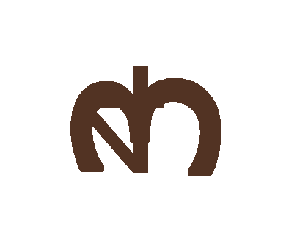
The Hanged Man in Tarot decks that are derived from those originating in Milan in the 15th century show a figure upside down suspended by one foot, with the other leg crossed at the knee. His arms are tucked behind his back. Students of the Tarot have observed that the pattern of the crossed legs forms an inverted four (4), while the arms resemble a sideways three (3). Our logo abstracts the numbers, yielding a trident-like image with the three sideways at the bottom and the upright of the four extending up. The Hanged Man’s number 12 can, of course, be factored into 3 and 4. The Hanged Man carries many potential meanings, but a key connotation is a change in perspective.
About Clark Kee
When I was in fourth grade, if you finished your work early you got to go to the library. My favorite spot in the library was the mythology corner. There were three books in a series that retold the Greek, Roman, and Norse myths. And I read and re-read them. When my parents found out they asked me what I thought myths were, and I said I thought they were stories that people told each other to explain things that they didn’t understand.
Freshman year of college I planned to major in physics, but eventually I majored in the anthropology of storytelling. And among the books in our syllabus was Jung’s Memories, Dreams, and Reflections, which is a kind of a memoir written by him and his longtime personal secretary Aniela Jaffe.
I was briefly introduced to Tarot during that time. At a social gathering a classmate produced a Tarot deck and prevailed upon each of us to exchange a single card. I was given the Page of Cups, who I came to refer to as a “student of sentiment.”’
Fast forward about 30 years….
While vacationing on St. Maarten in the Caribbean I stopped in a cluttered shop on Back Street in Phillipsburg and stumbled on a Marseille Tarot deck. It was different from the deck my friend had in college – which I learned had been what’s now called the Rider-Waite-Smith deck. The Marseille deck seemed older, which it is, and stranger, which it also is. But that reawakened my interest in Tarot.
As you can tell from the name of this website, the way I work with Tarot cards is related to what Jung referred to as “amplification.” He used the term to refer to a method of dream interpretation that compares the images in a dream to images from myths and other sources. In this case the Tarot spread is like the dream, and we develop an interpretation by drawing parallels to images and patterns in myth, history, literature, and culture.
In 2025 I became a certified Jungian Tarot Reader, having completed the Jung Platform’s Tarot Reader Certificate Program taught by Jungian analyst Ken James.
- C.G. Jung, Visions: Notes of the Seminar Given in 1930-1934. Edited by Claire Douglas. 2 vols. Routledge, 2019. ↩︎
- CW 9/1, 81. Note: we refer to Jung’s collected works using a standard reference style, where CW indicates collected works, and is followed by a volume, a part number if present (i.e. volume/part), and a paragraph number. This method allows the reference to be mapped to different editions where page numbers might not be consistent. You can find a list of Jung’s collected works here. ↩︎